

Battery in Lock
None
Retrofit Time
< 5 min
Access Record
Every tap
§01
FILE: PREMISE
Most office filing cabinets still use a 50-year-old lock design.
Walk into most offices today and the filing cabinets look almost exactly like they did in 1975. Same drawers, same flimsy tubular locks, same drawer full of mismatched keys nobody can identify. The furniture industry kept building cabinets. For the office segment, the lock industry never really caught up.
What changed is everything around the cabinet — the people who use it, the documents inside it, and the rules governing how those documents must be protected. A modern office runs on staff turnover, hybrid schedules, and privacy regulations that did not exist a generation ago. The 1975 lock is no longer fit for that world.
The fix is not a better key. It's the end of key chaos altogether.
A "tubular pin tumbler lock" — the small round-keyed lock found on most office cabinets — was patented in 1933 and standardised in office furniture by the late 1960s. Most office filing cabinets still ship with this exact mechanism.
§02
FILE: MECHANISM
How NFC battery-free file cabinet locks work.
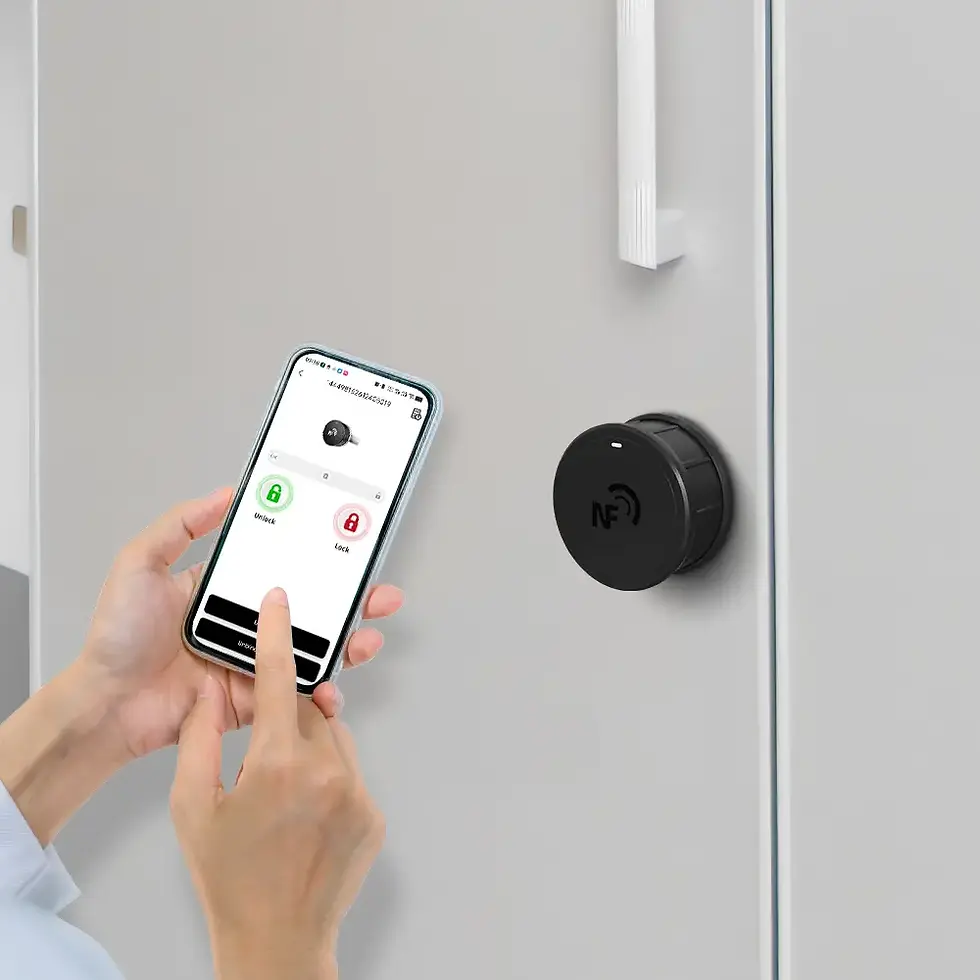
The lock has no internal battery. When an authorized smartphone is tapped against the lock, the phone's NFC field provides the power needed to verify credentials and release the lock — in one to two seconds.
STEP 01
No battery in the lock
Cabinets installed in a conference room or a back-office corridor don't require routine battery maintenance.
STEP 02
No keys to lose or copy
Access is granted, revoked, or reassigned in the app — no locksmith, no re-keying.
STEP 03
Every unlock is recorded
Each access event captures the time, the user, and the specific cabinet that was opened.
Two app versions
A cloud-connected version syncs access records to a central administrator dashboard in real time. A fully offline version keeps records on the user's phone and the administrator's device — ideal where network independence or data residency matter. Both versions support the same unlock and access-record functions.
NFC = Near Field Communication. The phone's antenna inductively transfers a small amount of energy to the lock's antenna at close range — enough to power the lock's mechanism for one unlock action.
§03
FILE: PAIN POINTS
Five pain points NFC file cabinet locks solve.
Each one is a daily-life problem in offices that run on mechanical cabinet keys. They compound. The lock is the first place to fix it.
01
Nobody can say where the keys are.
After ten years of operation, a typical office has more keys than cabinets and no record of who holds what. Borrowing keys becomes a daily social activity. NFC removes the keys entirely.
02
Every departing employee is a security hole.
When a staff member leaves with a key — or a copy of one — the only safe response is to re-key. Most offices skip this step and accept the risk. With NFC, revoking access takes seconds and changes nothing about the hardware.
03
Shared cabinets have no real accountability.
Five people on a team share a cabinet, five people have keys, and nobody can say who opened it last Thursday. NFC ties every unlock to a named user, automatically.
04
Privacy regulations are tightening every year.
Law firms, medical practices, HR departments, and insurance offices face direct regulatory pressure on how personal data is physically secured. NFC locks produce the access records those frameworks expect.
05
The hidden cost of locksmiths adds up.
Replacing a cabinet lock typically costs $60–$200 in parts and labor; cutting a duplicate key adds another $5–$20.1 Across fifty cabinets over a few years, this becomes a budget line nobody tracks but everybody pays.
Yelp Cost Guide for cabinet lock services and Fixr Locksmith Service Cost Guide — see footnotes at end of page.
§04
FILE: COMPLIANCE
Privacy compliance for document storage.
Modern privacy frameworks require that personal data — whether client records, patient files, employee documents, or financial paperwork — be protected against unauthorized physical access. The cabinet that holds the paper is part of the regulated environment.
NFC battery-free file cabinet locks capture three pieces of information at every access event:
When
Timestamp
Who
Authorized user
Which
Cabinet ID
These records form the foundation of physical access documentation expected by privacy and information-security frameworks worldwide.
International standards (apply broadly across regions):
ISO/IEC 27001:2022 Annex A.7
Physical controls, including access to information processing facilities and assets.
ISO/IEC 27701:2019
Privacy information management system extending ISO/IEC 27001 with privacy-specific controls
Regional examples — KENRONE access records support documentation under your applicable jurisdiction's framework, including:
Europe & UK
GDPR Article 32, UK GDPR
North America
HIPAA 45 CFR §164.530(c) (paper PHI in filing cabinets; for cabinets storing electronic media, §164.310(d) Device and Media Controls also applies), CCPA (Cal. Civ. Code §1798.150), PIPEDA Principle 7 — the Canadian Office of the Privacy Commissioner specifically identifies locked filing cabinets as a recommended physical safeguard.
Asia-Pacific
Singapore Personal Data Protection Act (PDPA), Korea Personal Information Protection Act (PIPA), Japan Act on the Protection of Personal Information (APPI), Australia Privacy Act 1988.
Middle East
UAE Personal Data Protection Law (Federal Decree-Law No. 45/2021), Saudi Arabia Personal Data Protection Law (PDPL).
The lock alone does not make an organization compliant — compliance is a matter of policy, training, and process. But the lock closes the most common gap in physical privacy controls: the missing access record.
Official citations for each framework appear in the footnote section at the bottom of this page, linked to the primary source (eCFR, Office of the Privacy Commissioner of Canada, etc.).
§05
FILE: RETROFIT
Drop-in retrofit for existing file cabinets.
Many office filing cabinets use standard 19mm or 22mm cam-lock cutouts, including common vertical, lateral, 2-drawer, 4-drawer, and mobile pedestal cabinets. NFC battery-free cam locks can retrofit these cutouts directly. For gang-lock, proprietary, recessed, or non-standard mechanisms, send photos or cabinet model details for compatibility review.
No drilling, no wiring, no replacement furniture, no procurement cycle.
Typical Retrofit Applications
-
2-drawer and 4-drawer office cabinets
-
Mobile pedestal cabinets under desks
-
Lateral file storage walls in records rooms
-
Shared office storage cabinets in open-plan environments
A typical retrofit takes under five minutes per lock with a standard screwdriver. Existing keyed locks can be swapped one cabinet at a time, on the office team's own schedule — no business interruption.
Standard cam lock cutouts: 19mm and 22mm diameter. KENRONE NFC cam locks ship in both sizes to match virtually all commercial filing cabinets.
§06
FILE: TURNOVER
Staff turnover, re-keying, and the case for keyless.
People change. The lock doesn't need to.
In U.S. workplaces, average annual voluntary turnover is around 13%, with total separations (including role changes and involuntary exits) substantially higher.6 In an office of fifty people, that's six to fifteen transitions every year. Each transition raises the same question: what about the keys?
The traditional answer involves a locksmith, a purchase order, and an afternoon of disruption — repeated for every cabinet that staff member had access to.
Most offices choose to skip this step and quietly accept the risk that copied keys remain in circulation.
NFC battery-free locks change the question. When an employee joins, access is granted in the app. When they leave, access is revoked in the app. The cabinet is never touched. The lock is never replaced. The hardware lifecycle finally matches the people lifecycle.
U.S. Bureau of Labor Statistics (JOLTS); SHRM and Mercer 2024–2025 turnover benchmarks.

§07
FILE: COMPARISON
NFC battery-free vs. mechanical vs. battery-powered smart lock.
The same comparison your purchasing committee will eventually make. Run through it now.
Attribute | Mechanical Lock | Battery-Powered Smart Lock | NFC Battery-Free Lock |
|---|---|---|---|
Unlock method | Physical key | App / RFID / keypad | Smartphone NFC tap |
Key management overhead | High | Low | None |
Battery in lock | None | Required (12–24 mo replacement) | None |
Wiring needed | None | Sometimes | None |
Access records | None | Yes (when battery alive) | Yes, every access |
Lock change on turnover | Re-key required | Revoke in software | Revoke in software |
Suitable for office use | Mid | Mid (battery hassle) | High |
5-year total cost | Mid + locksmith | High (battery + service) | Low |
§08
FILE: SPECIFICATIONS
Specifications.
The hardware. Documentation available on request, including datasheet PDF, installation guide, and API/SDK reference for integrators.
NFC Battery-Free Cam Lock | KR-NFC-CL |
|---|---|
Certifications | CE · FCC · RoHS |
Integration | API + SDK available |
Offline operation | Yes (offline app version) |
Users per lock | Not limited |
Phone support | Android & iOS NFC |
Unlock time | 1–2 seconds |
Operating temp | −20°C to 65°C |
Body material | Zinc alloy |
Body diameter | 19mm / 22mm |
§09
FILE: SUPPLIER
Why KENRONE.
About KENRONE : We have manufactured locks for over two decades. NFC battery-free locks are not a side project — they are the direction we are building our business around.
01
Factory-direct.
No layers between the production line and your project. Pricing reflects what the hardware actually costs to build.
02
CE, FCC, and RoHS certified.
Documentation available on request.
03
Flexible order sizes.
From pilot quantities to large rollouts, MOQ is set per project, not per catalog.
04
Custom housing, branding, mechanical interfaces, and firmware-level adjustments are part of our regular workflow.
05
Open integration platform.
Documented APIs and SDKs let you integrate unlock, credential management, and access records into facility management software, HR platforms, or custom mobile apps.
06
Complete English documentation.
Datasheets, installation guides, and integration notes available for every product line.
§10 · TALK TO US
Tell us about the cabinets you need to secure.
We'll respond with the specifications, samples, or quote your project actually needs.
§11
FILE: FAQ
Frequently asked questions.
References & Footnotes
-
Locksmith service costs_ Yelp Cost Guide \ Fixr Locksmith Cost Guide
-
ISO/IEC 27001:2022 + ISO/IEC 27701:2019 — International information security and privacy management standards. ISO/IEC 27001:2022 consolidated previous physical security controls into Annex A.7. ISO/IEC 27701 extends 27001 with privacy-specific controls aligned with GDPR requirements.
-
EU & UK privacy frameworks — GDPR Regulation (EU) 2016/679, Article 32 ("Security of processing"). UK GDPR retains the same Article 32 text under post-Brexit UK law (Data Protection Act 2018 as amended)
-
North America privacy frameworks — HIPAA Privacy Rule 45 CFR §164.530(c) "Safeguards" (per U.S. HHS guidance, applies to PHI in any form including paper records). California Consumer Privacy Act, Cal. Civ. Code §1798.150 (reasonable security procedures and practices). PIPEDA Schedule 1, Clause 4.7 — the Canadian Office of the Privacy Commissioner's official guidance lists "locked filing cabinets" as an example of an appropriate physical safeguard.
-
Asia-Pacific privacy frameworks — Singapore PDPA 2012 (as amended); Korea Personal Information Protection Act (PIPA, 2011 as amended 2020); Japan Act on the Protection of Personal Information (APPI, 2003 as amended 2022); Australia Privacy Act 1988 (as amended). All include physical-safeguard requirements for personal information processed and stored on premises.
-
Middle East privacy frameworks — UAE Federal Decree-Law No. 45/2021 on the Protection of Personal Data (in force 2022). Saudi Arabia Personal Data Protection Law (PDPL, issued 2021, effective 2023). Both prescribe technical and organizational measures protecting personal data including against unauthorized physical access.
-
Workforce turnover data — U.S. Bureau of Labor Statistics (JOLTS); SHRM and Mercer turnover benchmarks (2024–2025).