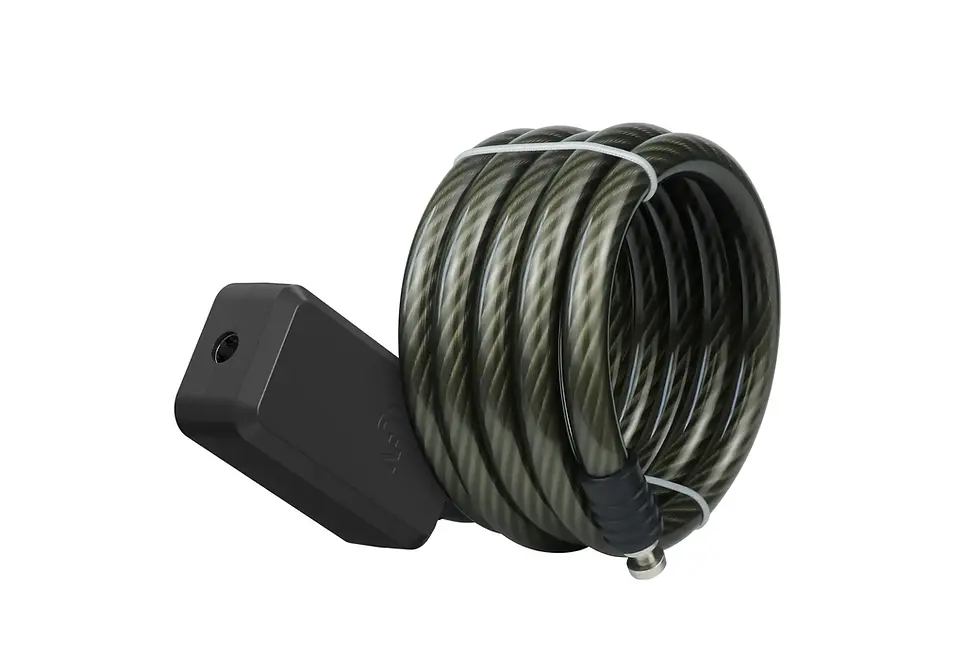
NFC Smart Bike Cable Lock -
No Charging Required
Your phone is the key. No lock battery, no physical keys, no codes — just the app you already have on the device you already carry.
-
Open the app, tap the lock — the latch releases, you slide the cable out by hand.
-
Braided steel cable wraps frame, wheel, and rack in one pass.
-
Built for daily commutes, campus, office, and short stops.
Honest about what a cable lock is — and what it does well.
A cable lock isn't a hardened U-lock, and we're not going to pretend otherwise. What this lock is built for is everyday parking: the bike rack outside the café, the office bike room, the spot beside the lecture hall.
For those situations, security means three things — a steel cable thick enough to stop hand tools, a hardened body that doesn't pop with a tap, and a digital key that can't be picked or copied at a hardware store.
01 — Cable
Braided steel core
Multi-strand steel inside a PVC jacket. Resists wire cutters and casual tampering at the level a cable lock can — and protects the frame finish.
02 — Body
Hardened lock body
Zinc-alloy housing with a hardened steel locking pin. Stands up to pulling, prying, and impact at typical opportunistic theft attempts.
03 — Key
Copy-proof digital key
Pairs with authorized phones through encrypted NFC. No physical key to copy at a kiosk. No combination to shoulder-surf at the rack.
Less to carry. Less to charge. Less to forget.
Locks fail people in small, annoying ways. You forget the key. You can't remember which combination you set last summer. The Bluetooth lock you bought a year ago is dead in the rack because you haven't ridden the bike in a month.
Your phone is the key. As long as you have it on you, the lock works.
This lock removes the parts that usually go wrong:
-
No keys to lose, copy, or fish out of a backpack
-
No combinations to remember when you haven't ridden for a while
-
No lock battery to charge before you can leave the house
An obvious question
“ But isn't a key faster ? ”
For the moment at the rack, yes — turning a key beats opening an app by a few seconds. The difference shows up everywhere else: the key you forgot at home, the spare you lost last month, the one your roommate borrowed and didn't put back, the cut-and-replace fee when you can't find any of them.
NFC trades two seconds at the rack for never thinking about keys the rest of the time.
The difference between a 600 mAh problem and not having one.
Most smart bike locks run on an internal battery, typically around 600 mAh. It charges over USB-C every few weeks — more often in cold weather. Forget once, and you're standing next to your own bike with a dead lock.
This lock works differently. The lock body has no battery inside. When you tap an authorized phone against it through the app, the phone's NFC field releases the locking latch — and that's the only thing electricity does here. You pull the cable out by hand. To lock up, you push the cable back in until it clicks. Mechanical, like any cable lock you've used before.
Because the electronics only run for the fraction of a second it takes to release a latch, there's no battery to keep alive between rides:
-
The lock that sat in the garage all winter releases on the first ride of spring
-
No USB-C port to corrode after rain, dust, or road salt
-
No lithium battery to degrade after two seasons of partial-charge cycles
-
One less thing on the charging shelf at home
How it works
Four steps from rack to road
Step 01
Open the app.
Pull out your phone, unlock it, open the lock app.
Step 02
Tap the lock.
Hold the phone against the NFC zone on the lock body. The app authenticates, the latch releases inside.
Step 03
Slide the cable out.
Pull the cable end free by hand. The lock is open.
Step 04
Ride.
That's the whole flow. Total time: around five seconds once the app is open.
To lock up again
Push the cable end back in until it clicks.
The latch engages mechanically. No phone, no app, no tap needed to lock. Even with a dead phone at the rack, you can still secure the bike.
The app verifies your identity before the latch releases. Unlike contactless payment, this lock doesn't trigger from a locked-screen background tap — opening the app is a deliberate authorization step.
One cable, several ways to lock up.
The cable bends where a U-lock can't. Loop it through the frame and a fat lamppost. Run it through both wheels and a thin railing. Wrap it around a tree at a trailhead where the rack stops being a rack.
The cable does what the spot you actually parked at will let it do.

Frame + rack
Wrap through the rear triangle and around a standard bike rack.
Frame + wheel + post
Single pass secures the bike and a removable front wheel together.
Awkward fixtures
Fits trees, signposts, fence rails, and irregular shapes a rigid shackle can't reach.
Two bikes, one lock
Long enough to chain a partner's frame to yours at the same rack.
Cable length: 100 cm — long enough for two bikes when you need it.
Keyed, combination, battery, or NFC?
A side-by-side against the three other formats this product competes with on the shelf.
Comparison | Keyed Cable Lock | Combination Cable Lock | Battery Smart Bike Lock | NFC Smart Cable Bike Lock |
|---|---|---|---|---|
How you unlock | Physical key | 4–5 digit code | App / Bluetooth | Phone NFC tap |
Carry a key? | Yes | No | No | No |
Remember a code? | No | Yes | No | No |
Charge the lock? | No | No | Yes, every few weeks | Never |
Works after months unused? | Yes | Yes | Often no | Yes |
Replace lost access | Cut and replace lock | Reset code | App reset / master key | Re-pair via app |
Best for | Basic lock-up | Keyless basics | Connected features | Daily keyless lock-up, no battery hassle |
Fingerprint locks belong in the same column as battery smart locks — same charging cycle, same problem when the battery goes flat. U-locks and chain locks still win on raw security for overnight street parking in high-theft cities. This lock is for the rest of life: commute, campus, office, café stops.
Where it earns its place on the frame
Use case / 01
Daily commute
Racks at the office, station, café, gym. The everyday workhorse.
Use case / 02
Campus parking
Students moving between buildings several times a day.
Use case / 03
Shared and fleet bikes
Rotate riders by re-pairing in the app — no key handover.
Use case / 04
Off-season storage
Sits in a pannier or garage for months without losing charge.
Use case / 05
Light vehicles
Scooters, kick scooters, folding bikes — anywhere a bike rack works.
Use case / 06
Secondary locking
Pairs with a U-lock for the wheel, seatpost, or accessories.
For overnight street parking in high-theft areas, pair this with a hardened U-lock or chain. That's true of any cable lock on the market.

Spec sheet
Item | Parameters |
|---|---|
Certifications | CE / FCC / RoHS |
Charging requirement | None |
Color / model | Black |
Net weight | 665 g |
Operating temperature | −20 °C to 65 °C |
Weather suitability | IP65 — rain and dust resistant for outdoor use |
App support | iOS/ Android |
Lock body battery | None |
NFC unlocking | Smartphone NFC (iOS and Android) |
Lock body material | Zinc-alloy housing, hardened steel locking pin |
Cable material | Multi-strand braided steel core, PVC outer jacket |
Cable diameter | 11 mm |
OEM and ODM programs for brands, retailers, and distributors
We manufacture this NFC cable lock for retail brands, bike-shop chains, fleet operators, and corporate channels. Standard SKUs ship from stock for sampling; custom programs are quoted against your spec.

What you can customize
-
Logo engraving on the lock body
-
Retail packaging — color box, blister, brown box
-
Branded app skin and account flow
-
Color, cable length, and diameter within tested ranges
-
Master account and fleet management for shared-bike use